Regional Suites
Beskidy Slask
From the Upper Silesia or Sląsk region in Southwest Poland. We have two suites from the Beskid mountains. Here is a translation of the lyrics of one of the songs.
Kołomajki (the name of the dance). The clothier took the blacksmith’s daughter, Maryna for his wife.
The blacksmith’s daughter Maryna has paper shoes and when she puts them on, she dances the kołomajki.
When you dance the kołomajki, however, watch out for the stove. The stove will be needed for the winter since not everybody has a down quilt.
Dances from this region include Owieziok, Wrona, Koło Naszej Masztolki, Kołomajki (see video), Swiniok (piglet), Kucznierz, Linder, Kroczek (tiny step) and Piłka (saw).
Choreography by Zosia; choreography by Jacek Marek |
Return to map
Bilgoraj
Janosik visited this village in southeast Poland in 1989. This suite was acquired there and in 1991, Janosik was first to present the dances in North America.
Choreography by Wanda Olszewska |
Return to map
Tance Cieszynskie — Dances from Cieszyn
The ancient town of Cieszyn on the Czech border is in the Upper Silesia or Slask region in Southwest Poland. Janosik dancers collected the songs and dances during visits in 1972 and 1974. Dances from this region include “Hej na moscie,” “Trojak” for two girls and one boy, “Lipka,” and “Szpacyrpolka.”
Staging by Morley Leyton |
Return to map
Kujawy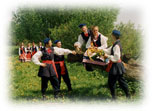
Janosik learned these dances while touring northern Poland, hosted by the group, Zespól Piesni i Tanca „Toruniacy” in 1993. They learned them from a teacher and a musician from that region. The dances included are a March, Chodzony, Kujawiaks, Mazurek and Oberek.
Choreography by Jadwiga Kurant |
Return to map
Tance Lubelskie — Dances from Lublin
Lively folk dances demonstrating the influence of gypsies on Polish folklore. The songs that Janosik sings are “Walczyk Lubelski,” “Cygan,” and the popular “Mach.”
Choreography by Spigniew Kwiatkowski, staging by Chrissie Forward |
Return to map
Nowy Sacz
This suite from southern Poland begins with a lively men’s Krakowiak, where the men demand that the musicians play for them, followed by Sztajerek, Krzyzok, Cieta Polka (see video), and Chodzony.
Staging by Leonard Kress |
Return to map
Tance z Opoczynski — Dances from Opoczno
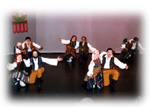 These spirited and energetic dances are from a region southeast of Warsaw. Polka Treblanka, a light-hearted three-beat Polka and Oberek Opoczynski, a breathless Oberek, another of the national dances of Poland, including acrobatic solos, and ending in a whirl of color. Learned from the famed group, Mazowsze.
The terrain there lends itself to sheep pastures so they are known for their woven work — particularly the striped fabric that is used for costumes, bedspreads, and more. In one of the several trips to Poland some of our group had the chance to visit the place where this fabric was made.
These spirited and energetic dances are from a region southeast of Warsaw. Polka Treblanka, a light-hearted three-beat Polka and Oberek Opoczynski, a breathless Oberek, another of the national dances of Poland, including acrobatic solos, and ending in a whirl of color. Learned from the famed group, Mazowsze.
The terrain there lends itself to sheep pastures so they are known for their woven work — particularly the striped fabric that is used for costumes, bedspreads, and more. In one of the several trips to Poland some of our group had the chance to visit the place where this fabric was made.
Choreography courtesy of Mazowsze with Morley Leyton |
Return to map
Tance z Podhale — Dances from Podhale
This is the region where the group’s namesake originates. Many of the dances from this region in the Tatra Mountains are done by shepherds. One song tells about life of a girl and her sweetheart deep in the mountains, a place called “Jurgów.” Another song is entitled, “Hej Bistra Woda” and is sung in the famous “white voice” of the mountaineers. Also seen is the shepherd “krzesany,” concluding with the thrilling men’s “zbojnicki.” | Return to map
Piosenki i Tance Rzeszowskie — Songs and Dances from Rzeszów
The southeast corner of Poland is known for their earthy dances with lots of complicated turns and pivots. . This region has been inhabited by Polish people since the Middle ages. Between the 14th to 17th centuries the folk culture flourished there and was known for its richness and variety because of influences by different ethnic groups. The words fo the songs are frequently nonsense and the dancers have to sing while dancing. This suite contains the dances “Bednarz, Polka Przez Noge, Jacok, Krzyzak, Polka Trzesionka, Wolny, Polka Przeworska, Polka Uginana, Polka Suwana, and Lasowiak.”
Choreography by Edek Wawrzyniak and Morley Leyton
Przeworsk
One of the dances in Janosik’s Rzeszów suite. This is a dance from a old town of Przeworsk (21 miles east of the city of Rzeszów) that became popular throughout the entire Rzeszów region. American folk dancers gave it the nickname of “Five-and” for its complicated timing. Also known as wsciekla or wild polka, the tempo quickens as the music progresses. | Return to map
Sieradz
This suite from central Poland was acquired in 2000. It consists of many fast turning dances and even a game with a broom. “Chodzony”, “Owiok”, “Wehsel”, and “Polka.”
Choreography by Teresa Debska |
Return to map
Tance z Wielkopolski
From the region of Great Poland in western Poland. This area is believed to be where the nation was born. As the region is close to the German border the dances have a hint of Austrian/German influence with the inclusion of waltzes.
Many of the dances involve the use of a whip called a “harapnik” by the men. The whip isn't the same as one used driving a horse carriage. It is shorter and its handle is made out of a rodeer leg. The lady uses a handkerchief or “chusteczka” and she is adorned with lace.
Throughout the suite you hear some calls such as “Wiwat” which means “long live.” Others are the leader calling out the name of the dance. At the end the dancers sing a phrase which means “It would be good to have something to drink” — a sort of proclamation.
Choreography by Jacek Marek |
Return to map
Tance Stara Warszawa — Dances from Old Warsaw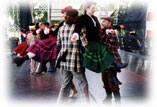
Contrary to the name, this is the most modern suite of Janosik’s repertoire. A group of dramatic tangos and playful polkas as done by the working people in Warsaw between the First and Second World Wars, this suite displays the unique character of Warsaw street life.
Choreography by Cieslaw Kujawski and Morley Leyton
Polka Mazurka
Ballroom dance from the elegant salons of Warsaw, circa 1850. It combines elements of the Polka and the Mazur. Janosik is the only group performing this dance in the United States.
Choreography by Monique Legaré and Morley Leyton |
Return to map
Tance Gorale od Zywca
Songs and dances by the Zywiec “gorale” (mountaineers) in the Beskid Mountains. The troupe visited there in 1977 to learn the dances. The suite begins with “Kon” (horse). Then continues with “Siustani,” “Hajduk” (see video), and other songs.
Choreography by Maria Romowicz, Jodly Ensemble, Zywiec, Poland |
Return to map
Home | About Us | Repertoire | History | Join Us | Contact Us | Links | News
Copyright © 2010, Janosik Polish Dance Ensemble